Category: Spirituality

  • Identical Twin, Different Generation

    I had already primed myself for uncontrollable gushes of happy tears when I learned about the lesbian hippie commune magazine Country Women.

    Reading its stories, which often doubled as its members’ daily diaries, sent me into the kind of wistful whirlwind that lingers for days after seeing pictures of Woodstock — leaving me a hair-triggered mess that starts crying at the smallest reminders of the happiest times of my youth.

    When you’re pushing 70 like I am, the depth of first-hand historical experience that age gives a person endows the bearer with the ability to explain across three generations what made things the way that they are today. It also burdens the bearer with the sadness of bereavement over the beautiful things of the past that appear to have passed away.

    But nothing prepared me to meet my identical twin.

    A Looking Glass That Transcends Time

    Pictured on page 25 of Issue 7 is a member of the commune who looks exactly like me. Exactly. Right down to the unequal lengths of the long hair that drape from each side of my shell-shocked head, a distinctively individual quirk that I keep on purpose for the purpose of proclaiming to the world, “I am unique.”
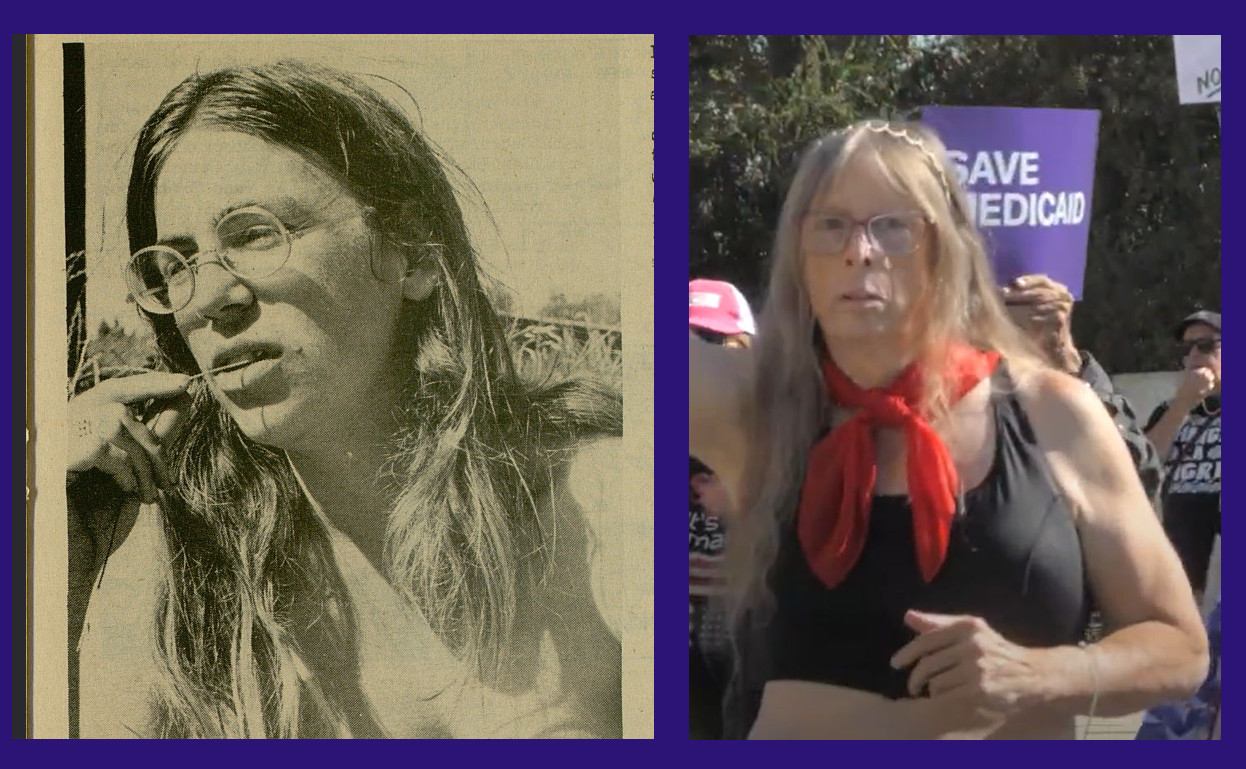
    Left: My twin. Right: Me at age 68, being peacekeeper at a No Kings march.

    Look at my picture on this site. We look exactly alike. Same build. Everything.

    Her story begins, “I was working naked in the garden.” I loved to work naked in the garden. Hell, I did my entire rear landscaping nude, right down to installing the sprinkler system, and I was approximately her age when I did it.

    There she is. My identical twin. From a different generation.

    Metaphysical and Paranormal Ramifications

    While she was an adult living the most perfect existence imaginable to humankind, I was a child who dreamed and longed to live a utopian existence exactly like hers.

    Can the same person exist in two places at once, spanning different times? The field of the paranormal opens into a vast meadow of unbounded speculation and conjecture.

    Classical reincarnation postulates that an individual’s nonphysical being experiences rebirth as a new being or in a new body after biological death. But nothing prohibits reincarnation from taking place within overlapping time frames of temporal existence.

    My own view of reincarnation is less confined by the concept of discrete souls that can occupy only one body at a time. I envision reincarnation that permits a spiritual essence to experience the temporal realm through more than one window, i.e. biological body, at a time. One essence, more than one body at the same time.

    Or, perhaps, it’s just one incredible coincidence. But it’s a coincidence that breathes into me new life.

    Transformation, Again

    It is said that having goals and purpose in life is a key to living long. I hope that is true, because I now feel an impossible longing to experience everything that can make me into a broader person than I was before. “Everything” is an awful lot of lived experience to be had, and experiencing it is going to require an awful lot of time.

    I want this. I want this hippie commune experience so intensely. If I can’t experience everything that is exciting and broadening, I at least want this.

    I am feeling the longing drive of my mid-20s. Again.

  • From Ancient Remnants, A Revived Path

    Thoughts on Samhain for Any Time of Year

    Forgotten but not gone, we see them; unbeknownst to us, we walk past them. Unaware of their etymology, we even utter them: remnants of faded meaning and erstwhile traditions that, while nearly obscured by centuries of cultural overgrowth, still exist to be found and enjoyed once you learn how and where to look for them.

    In the fourteenth century, the word “spring” was a verb meaning “to leaf out.” Over the next hundreds of years, the season in which bushes and trees would spring would come to be known as “spring” or “springtime.”

    The remnants of early Paganism today

    Few realize that when we observe Groundhog Day, today a rather silly “holiday” that remains nonetheless on our calendars, we are observing an ancient remnant of Imbolc, the Pagan holiday tied to divination of the weather. Groundhog Day and Imbolc both fall on February 2. The May Pole and May Day, likewise, have their distant roots in Beltane, May 1 or April 30.

    Better known and much more conspicuous are the Pagan roots of Easter, or Ostara. Associated with Easter eggs and bunnies and other symbolism that has nothing to do with the crucifixion and resurrection of Christ, some Christians now prefer the alternative name Resurrection Day in Christian contexts.

    Yet even Resurrection Day is still tied to the first Sunday after the first Full Moon after the Spring Equinox – a schedule set by pure Pagan tradition. Which brings us to Samhain.

    “Ancestors’ Nights” often have Pagan origins

    Is it coincidental that Dia de los Muertos and the Catholic All Saint’s Day fall so close to Samhain? These, too, are ancient remnants of Pagan spirituality that continue to brightly color our culture.

    Wiccans sometimes call Samhain Ancestor’s Night, because in the most literal traditional sense, the veil that separates this world from the next is most thin, making Samhain the easiest time to contact the spirits of departed loved ones. For those who reify their Pagan symbolism a little less than this, Samhain is a traditional time of remembrance.

    It is also considered the beginning of the new year by many, marking the end of the harvest and a time of planning for the winter and for new beginnings come next spring.

    This aspect of Samhain can be put to good use by anyone. People who are not spiritually inclined, or choose not to adopt the beliefs and symbolism of Witchcraft, can still, if they choose, use Samhain as a starting point to renew or reinvent themselves.

    Whether it’s these examples, or Halloween, or Yule (Christmas), so many modern traditional observations and celebrations still have not wandered far from the faded Pagan holidays to which they moored.

    From rediscovered remnants to a shared beauty

    This is not, however, meant to imply that “we Pagans were here first, so it belongs to us.”

    No, the Pagan roots of these traditions, and many others, belong to the Earth, which in turn exists and turns and springs equally for each of us – or ultimately to the glory of the Creator of the universe if you subscribe to a classical monotheistic faith.

    We Pagans, of course, associate with the Earth and Her cycles a particular form of spirituality – a spirituality that comes intuitively to us which we in turn use to supply meaning to the cycles of the Earth, the turning of the Wheel of the Year.

    It is these old, forgotten but not lost, symbols, markers and signposts that modern Pagans seek to restore for ourselves their former prominence and reverence.

    But we don’t own them; they shape our lives.

    One thing is for certain, though; the Christmas and Holiday season, so close to the calendar New Year, can mean new beginnings to all of us, just as it means the beginning of new rebirth to the Earth.