Author: Pamela

  • From Ancient Remnants, A Revived Path

    Thoughts on Samhain for Any Time of Year

    Forgotten but not gone, we see them; unbeknownst to us, we walk past them. Unaware of their etymology, we even utter them: remnants of faded meaning and erstwhile traditions that, while nearly obscured by centuries of cultural overgrowth, still exist to be found and enjoyed once you learn how and where to look for them.

    In the fourteenth century, the word “spring” was a verb meaning “to leaf out.” Over the next hundreds of years, the season in which bushes and trees would spring would come to be known as “spring” or “springtime.”

    The remnants of early Paganism today

    Few realize that when we observe Groundhog Day, today a rather silly “holiday” that remains nonetheless on our calendars, we are observing an ancient remnant of Imbolc, the Pagan holiday tied to divination of the weather. Groundhog Day and Imbolc both fall on February 2. The May Pole and May Day, likewise, have their distant roots in Beltane, May 1 or April 30.

    Better known and much more conspicuous are the Pagan roots of Easter, or Ostara. Associated with Easter eggs and bunnies and other symbolism that has nothing to do with the crucifixion and resurrection of Christ, some Christians now prefer the alternative name Resurrection Day in Christian contexts.

    Yet even Resurrection Day is still tied to the first Sunday after the first Full Moon after the Spring Equinox – a schedule set by pure Pagan tradition. Which brings us to Samhain.

    “Ancestors’ Nights” often have Pagan origins

    Is it coincidental that Dia de los Muertos and the Catholic All Saint’s Day fall so close to Samhain? These, too, are ancient remnants of Pagan spirituality that continue to brightly color our culture.

    Wiccans sometimes call Samhain Ancestor’s Night, because in the most literal traditional sense, the veil that separates this world from the next is most thin, making Samhain the easiest time to contact the spirits of departed loved ones. For those who reify their Pagan symbolism a little less than this, Samhain is a traditional time of remembrance.

    It is also considered the beginning of the new year by many, marking the end of the harvest and a time of planning for the winter and for new beginnings come next spring.

    This aspect of Samhain can be put to good use by anyone. People who are not spiritually inclined, or choose not to adopt the beliefs and symbolism of Witchcraft, can still, if they choose, use Samhain as a starting point to renew or reinvent themselves.

    Whether it’s these examples, or Halloween, or Yule (Christmas), so many modern traditional observations and celebrations still have not wandered far from the faded Pagan holidays to which they moored.

    From rediscovered remnants to a shared beauty

    This is not, however, meant to imply that “we Pagans were here first, so it belongs to us.”

    No, the Pagan roots of these traditions, and many others, belong to the Earth, which in turn exists and turns and springs equally for each of us – or ultimately to the glory of the Creator of the universe if you subscribe to a classical monotheistic faith.

    We Pagans, of course, associate with the Earth and Her cycles a particular form of spirituality – a spirituality that comes intuitively to us which we in turn use to supply meaning to the cycles of the Earth, the turning of the Wheel of the Year.

    It is these old, forgotten but not lost, symbols, markers and signposts that modern Pagans seek to restore for ourselves their former prominence and reverence.

    But we don’t own them; they shape our lives.

    One thing is for certain, though; the Christmas and Holiday season, so close to the calendar New Year, can mean new beginnings to all of us, just as it means the beginning of new rebirth to the Earth.

  • Defeating Hate 3: Live Your Freedom Exuberantly

    (Or, If It Feels Good, Do It)

    Hate and oppression depend on fear to inhibit and discourage communities from fully enjoying our liberties and living our lives to their self-fulling fullest. But we must bear in mind that being too afraid to take positive action will not eliminate the source of the fear. Allowing fear to prevent us from enjoying life only emboldens the agents of fear to oppress even more.

    In other words, there is more to be feared by allowing ourselves to be intimidated than in finding our courage in the face of evil.

    The insufficiency of advocating freedom in the abstract

    The United States has wallowed in ritualized, ceremonial proclamations of allegiance to freedom and liberty for an entire century. Every Fourth of July, we celebrate “liberty.” From coast to coast, our Pledge of Allegiance promises “liberty and justice for all” — even as the reality on the street is moving further and further away from these ideals.

    If repetitious proclamations of “liberty” actually made one damn bit of difference, our nation would not be on the verge of the total loss of its freedom and liberty at this very moment.

    Freedom must be practiced to be meaningful

    Freedoms tend to fade out of existence when they are never used. When a person, group, or society never exercises their freedoms, then no emotional attachment to those freedoms ever forms. When people or a society has no emotional investment in their liberties, there is little to no motivation to fight for them or preserve them.

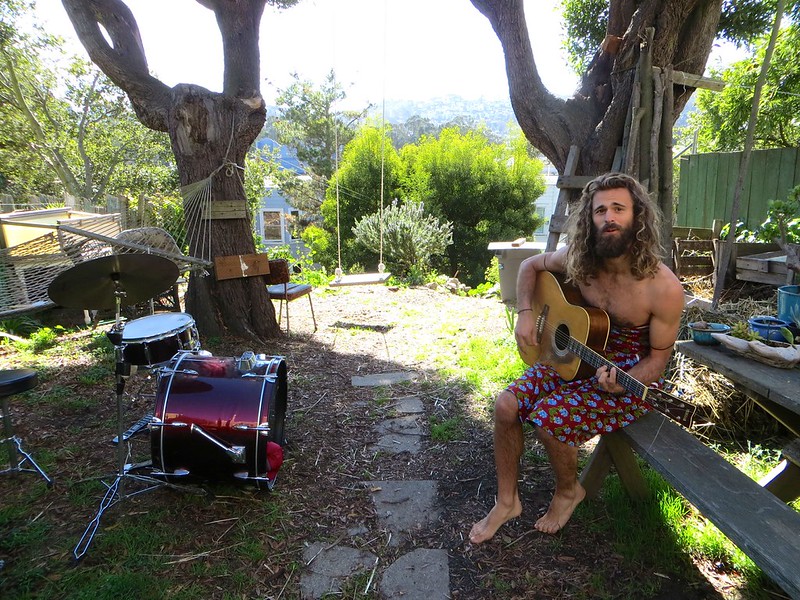
    Gorgeous guy with long hair and nice muscles
    Gorgeous guy with long hair, individualistic look, and nice muscles (Creative Commons)

    Freedom benefits most when we practice it in view of others

    For freedom to really take off like wildfire, let the world see you living it! Courage is contagious, and the more people who dare to be themselves and “do their own thing” as we said during the Counterculture, the faster it will spread — and more importantly, the sooner it will be valued on a personal, emotional level.

  • Defeating Hate 2: Create and Spread Beauty

    Hate and oppression depend on fear to inhibit and deter communities away from taking positive, corrective, or constructive action. But we must bear in mind that being afraid to take positive action does not eliminate the source of the fear. Allowing ourselves to be intimidated only emboldens the agents of fear, resulting in even more fear.

    In other words, there is more to be feared by allowing ourselves to be intimidated than from finding our courage in the face of evil.

    Love can drive out hate. So can beauty.

    Have you ever noticed how hateful people try to destroy all things that are beautiful and uplifting? Hate movements would outlaw pleasant, sunny days if they could.

    So, start creating beauty. It can take the form of 1960s Flower Power art, Pride imagery, cheerful, uplifting, energizing movement music, or any other creation that lifts the spirits of those around it.

    Not creative? Then buy and gift beauty.

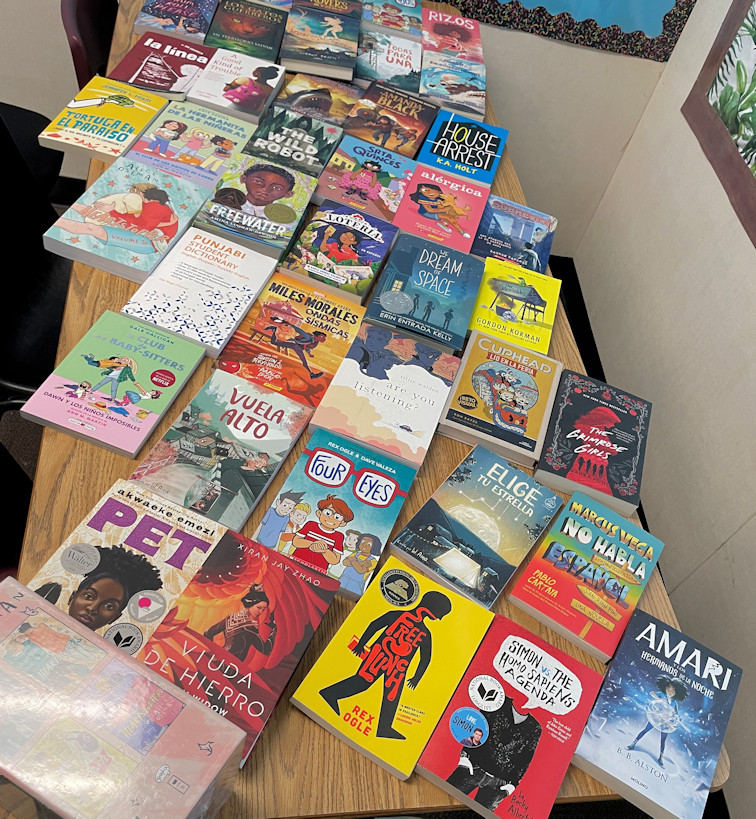
    One significant way that I spread beauty around my community and across the nation is to buy books for schools and classrooms here, there, and everywhere. I buy LGBTQ+ books for any teacher who requests them. I buy and gift Black History and Racial and Cultural Representation books, and I have funded LGBTQ+ Dances and Wellness Rooms for schools nationwide.

    Some of my book purchases for schools
    Racial and Cultural Representation books that I gifted to a local school

    Not only does this spread beauty in its more conventional guises, but it spreads beauty in a form that enrages hate movements the most:

    It spreads the beauty of human diversity far and wide, in a form that will have a lasting impact on the future: the eyes and minds of the next generation of adults who are today growing and learning about the diversity of the people around them in public schools everywhere.

    The beauty of human individuality can keep the garden of humanity healthy, well nourished and diversified.

    Supplies that I bought for a school's Pride club
    Supplies that I bought for a school’s Pride club
  • Defeating Hate 1: Proudly Normalize the Good

    Hate and oppression depend on fear to inhibit and deter communities away from taking positive, corrective, or constructive action. But we must bear in mind that shying away from positive action does not eliminate the source of the fear. Allowing ourselves to be intimidated only emboldens the agents of fear. Surrendering to fear will beget more fear.

    In other words, there is more to be feared by allowing ourselves to be intimidated than from finding our courage in the face of evil. The antidote is normalization of the good.

    Keep doing what the haters hate

    And do it proudly and openly. Remember that the vast majority of people in your community have not changed. Acceptance and tolerance has not disappeared from our society. The only thing that changed is that hate and intolerance has become emboldened and openly expressed.

    If you’re LGBTQ+ like I am, flaunt your Pride merch. Regularly refer to “pronouns” as they apply to gender identity. If your social media account allows you to set your gender pronouns and display them publicly on your account profile, do so.

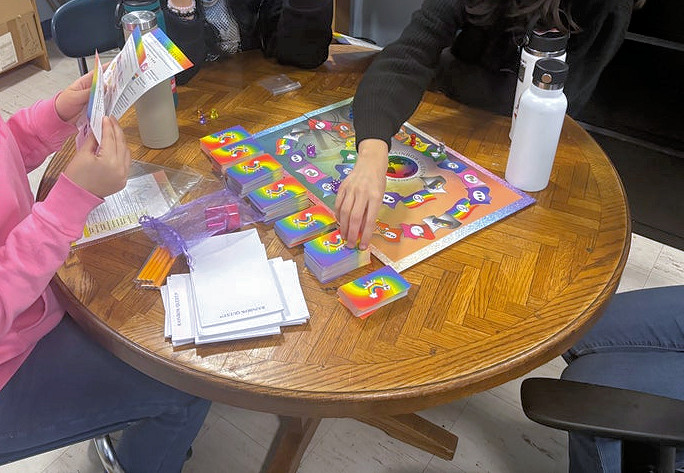
    Students playing the Rainbow Quest board game
    Students playing the Rainbow Quest board game

    And on social media, never hesitate to call out cruelty, violations of Constitutional rights or due process, just as you did before. Taking a stand for basic right and wrong doesn’t make you a leftist, not that there’s anything wrong with being a leftist.

    Calling out that kind of gross wrongdoing doesn’t make you a leftist. It simply makes you normal.

    And it’s the normal among us who need to be heard, in all of our majority’s numbers … once again.

  • Feminism and the Fountain of Youth

    Born in the late 1950s, I came of age in the mid-morning of the women’s movement. As a living, breathing, puzzling teenage conglomeration of old fashioned values, geekiness, and a passionate embrace of sexual liberation, I was alive to witness feminism’s rise to ascendancy during the assertively freedom-seeking energy of the 1970s.

    But one source of so many of my life regrets is my predilection for embracing a movement a decade or more after it had peaked. You see, I can also be reactionary; I have sometimes come to embrace movements only after years of balking at them, and feminism was one of them.

    My contradictory youth

    In the 1980s, while I eagerly embraced ’60s Counterculture sexual liberation and the expansion of women’s rights, I shortsightedly found the feminist movement‘s emphasis on abortion off-putting. Empathy being a strong, innate part of my being, I was driven to want to protect babies, both unborn and born. For several years, I was anti-abortion.

    You see, I was politically very clueless in my youth. I paid no attention to politics. Little did I know that I was about the only person who based her anti-abortion views on actual empathy for babies and not on misogynist religious dictates.

    I was a feminist at heart, but one who questioned some of the approaches of the movement. If that makes sense, right?

    Called to active duty for women’s rights

    Fast forward to today. After decades of American society believing that women’s rights were a done deal, never to be undone again, along came the 45th presidency, and two Supreme Court appointments later, the Constitutional protections that my generation (and Generation X) had counted on were suddenly dead and gone. Almost all of our basic rights now lay unprotected against malicious, malevolent legislative attack.

    Curled up in my bed with the current issue of Ms. magazine on my stalwartly pro-choice lap and a three year prepaid membership in the National Organization for Women under my garter, for perhaps the first time in my life I am entering a critical, relevant sociopolitical movement in its reinvigorated beginning rather than hitching my devotion to it after it had already run out of momentum.

    And it makes me feel young again. But this time, my new youth is powered by the wisdom of age.

  • Creeping Puritanism Paved the Way for Regression

    Those of us who came of age during the height of the Sexual Revolution, otherwise known as the Best Times in American History, Like Evah, looked upon the 1950s with disdain. The 1950s were scorned as puritanical, uptight, and repressed. Breastfeeding was frowned upon, open breastfeeding was unthinkable, and we spoke of menstrual periods in coded language like “a visit from Grandma.”

    The Sexual Revolution of the late 1960s and 1970s rebelled against that with vigor, and rebel, did we ever. Pushing against sexual repression together with the rising feminist movement, we propelled the United States into a realm of liberty and free personal expression that it had never seen before.

    And then came the 1990s.

    What Happened?

    Concession by tiny concession, Democrats in legislative chambers began surrendering that newfound love of sexual and expressive liberty in a misguided effort to placate a nascent social conservative movement. In a shocking betrayal of the Sexual Revolution, President Bill Clinton fired the incomparable Surgeon General Joycelyn Elders for merely stating a simple and obvious fact about masturbation. And American culture began to body-shame men who merely showed the amount of skin that the 1950s considered normal for males.

    Lloyd Bridges in Sea Hunt

    By the year 2000, any male who dared show as much skin as Lloyd Bridges in the 1960s TV series Sea Hunt suffered brutal ridicule and shaming that was heretofore never dreamed possible.

    The Fifties, only Worse

    But today, nearly all men wear long pants in the pool or at the beach, euphemistically called “board shorts,” and many wear shirts in the water as well. Any man wearing Lloyd Bridges’ trunks is safely assumed to be visiting from overseas. What in the hell happened to the body acceptance of the 1970s?

    Today, American culture has become so Puritanical that even the 1950s appear liberated in comparison. The only demographic today that seems to be keeping body acceptance alive is … wait for it … we in the Pride community.

    Liberty is like muscle; neglect it, take it for granted, and liberty will atrophy and fall into disuse. Over the course of a few decades liberty will not be valued anymore. Liberty becomes casually disposable.

    And that’s where we’re at.

  • At The Edge Of Knowability

    Dark is the symbolic color of mystery; its realm is the shadowed ramparts and recesses that wonder inhabits as it awaits the light of discovery that has yet to shine into it. This is no less true in cosmology, where unknown forces and factors often attract the adjective “dark.”

    “Dark matter,” for example, comprises the super-majority of matter in the known universe. Its name is due in part to the simple characteristic that it does not shine with any detectable radiation; yet it is dark with mystery as well because the known varieties of non-luminous and non-reflective matter nowhere near account for grand total of dark matter that, by virtue of dark matter’s detectable effects upon visible matter, the laws of physics say must exist.

    Even more mysterious is “Dark Energy.” Unlike dark matter, which is at least partially accounted for in forms familiar to scientists, Dark Energy is a little more than a placeholder for pending knowledge; nothing more is known about it than that it is a name given to whatever is causing the expansion of the universe to accelerate rather than coast by its own momentum, as a simple “Big Bang” progenitor explosion would lead one to expect.

    Dark Energy is what appears to be continuing to push the universe apart. Officially, we know nothing more than this.

    I believe I know what Dark Energy is. If I am correct, it is not energy at all, but a manifestation of a slow, steady change in the frame of reference by which we measure dimensions and velocities.

    Einstein’s theories of relativity are built upon the relativity of frames of reference and upon the relationship of gravity with the hyper-geometry of space; Einstein and Hawking went even further to predict that the staggering gravitational forces near rotating black holes (and presumably all black holes are rotating) exert bizarre effects upon both the nature of space-time in their vicinity, and even more bizarre effects on the frames of spatial reference near the event horizons of black holes.

    The concept of frames of reference are foundational to Einstein’s theories of relativity.

    But to write about the Lense-Thirring effect would be a diversion down a tangent of cosmic proportions, so I will jump ahead to my conclusion about Dark Energy so that I can get on with the show:

    I believe that Dark Energy is nothing more than the shrinkage of the frames of reference relative to any particle in space. The universe might not be expanding faster under its own power; we (and our frames of reference) might be getting smaller, shrinking our measuring sticks like an accidental trip through C.G. Spacely’s Minivac Machine. If we and our frames of reference are getting smaller, then the universe would appear to be getting bigger under the power of some unknown source of energy.

    And this, finally, brings me to consciousness.

    Consciousness is another enigma. How can it be that matter arranged in the form of Homo Sapiens and other higher animals can be said to possess consciousness, while other highly ordered structures of matter capable of making decisions (such as the computer chip) is just a lump of matter without consciousness?

    Yet consciousness is one of the few realities that survived the stringent standards of provability that philosopher and mathematician Rene Descartes demanded of justified true knowledge. Consciousness is both a enigma at the edge of purely physical verifiability, and one of the few absolutely certain facts that exist – a contrast that is almost, but not quite, a logical impossibility.

    We know that consciousness exists. Yet we tend to identify consciousness only in its familiar guise of organic life.
    There is no reason whatsoever to confine the logical possibility of consciousness to that which resides in organic life.

    In the television series Space 1999, the early episode The Black Sun introduced Commander Koenig to God, however briefly, where she said “I think a thought in perhaps a thousand of your years.”

    When you free yourself from preconceived notions that consciousness can only exist within organic bodies, and can only operate at familiar speeds, then cosmic intelligence, including Ultimate Cosmic Intelligence, becomes conceivable: indeed, very possible. With a possible eternity spanning countless births of universes, the self-organization of consciousness on a vastly different temporal and chronological scale begins to seem extremely probable indeed.

    If cosmic intelligence can be so vast as to be universal, then St. Thomas Aquinas could have a point in that Goddess is both transcendent and immanent. I’d hasten to question Aquinas’ claim that God is immaterial, however; if consciousness is the products of physical interactions of energies, then Goddess is very physical, though obviously not of a human form or anything resembling a familiar carbon-based biological entity.

    “If,” “could.” Speculation, undoubtedly. But I’ll leave it to you to decide for yourself if the edge of unknowability is enough for you to doubt the existence of the Divine in any form, or embrace the existence of the Divine in some form.

    But if I have proven anything, it is that no one human being can claim, beyond reasonable doubt, to possess the definitive truth as to the details of the Divine.

    If you believe in Him or Her, then trust. If not, then don’t. It’s all that you or I can do.

  • The Email from the Other Side

    Back in 2008, when the Bakersfield Californian had online reader blogs at their website, I started to become friends with a fellow blogger lady named Nancy G. We emailed back and forth for quite some time, and started to become friends. The friendship didn’t last, as our personalities proved to be incompatible, so we stopped emailing one another and never exchanged emails again.

    Years later, in 2014, I woke up to the news that Nancy G had been killed in an automobile accident. A Kern Sheriff’s deputy flew through an intersection at high speed, no lights, no siren, and smashed right into Nancy as she was driving. She had been to a Dodgers game earlier that evening.

    A few minutes after learning the news, after all these years, an email unexpectedly arrived in my inbox.

    It was from Nancy G.

    It read, “Heading home now.”

    Back in the day, an email would occasionally get delayed in transit at a particular server, and would continue on its way some time in the future. She sent it as she was leaving the Dodger Game. It got stuck in transit, and arrived only after I had read the news.

    I received an email … from the other side.

  • An Incredible Case of Clairvoyance and Premonition

    One night in 1986, while living in Los Angeles, I had a dream in which I was riding down the freeway in the passenger seat of a car. As we emerged from beneath an overpass, I looked up and to the left, and watched a small private aircraft approach a silver and red commercial airliner from visually above-right, the one o’clock direction from my point of view.

    The two collided, and the airliner took a rapid arc downward and crashed behind a tree-lined skyline into a residential neighborhood. Little did I know that my dream was in fact a premonition.

    My dream makes the news

    The next day, I turned on the television to see the news dominated by coverage of a passenger airliner crash. One news broadcast showed an animation of a small aircraft, colliding in mid-air with a red and silver Aeromexico airliner. The direction from which the small craft approached was exactly as in my dream, as was the diving path taken by the airliner afterward. I was watching my own damned dream, being played back on the evening news. I felt chills all over.

    I was, indeed, an eyewitness to the Cerritos air crash. The night before. In my dream. A real premonition of a deadly disaster.

    But if this sounds like a “routine” case of a dream predicting the future, the dream itself is the lesser part of my experience. The real blow-away chapter of the story follows.

    The utterly chilling confirmation

    Three years later, a coworker, with whom we usually ate lunch, needed cash, so we took a long detour to his bank in Whittier. On the way back, we headed south on the 605 freeway. I had never, ever been on the 605 freeway before. I lived in the San Fernando Valley at the time.

    I began feeling a tingling sensation and began looking around. “This place looks familiar,” I thought to myself.

    Within a minute, my skin really began to prickle as I began to recognize where I was, its hauntingly familiar skyline awakening dormant memories. When my friend drove under the next overpass, that’s when the significance of the scene truly hit me like a blast of cold water. “Oh, my God, this is it!” I recognized where I was. It was the exact vantage point from which I foresaw the Cerritos air crash in my dream, from the passenger seat of a car emerging from an under an overpass.

    I didn’t say anything at the time, but my heart was racing. When we returned to the office, however, I asked my coworker who was driving if we were anywhere near where the Cerritos air crash happened. He took a sheet of paper, penciled a rough map of the area freeways and drew an “X” at the site of the crash, and everything matched. The distance, the angle of sight from that location, everything fit.

    I had passed through, and recognized, a place and a scene that I had seen years before only in a dream. What I had seen in my dream is exactly what I would have seen from that spot, had I been there in person. The fact that I recognized the vantage point three years later, and remembered what I had seen there, even though I never had physically been there before, gave me all the proof that I needed that it wasn’t merely a horrible coincidence, but a real premonition.

    The emotion still comes over me when I recall passing over the spot. It’s an experience that will stay with me forever.